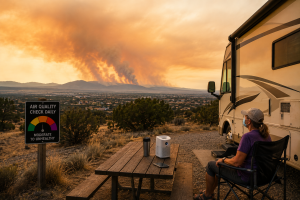
A hazy sky over Albuquerque in August doesn’t necessarily mean there’s a wildfire burning nearby — it might mean smoke has drifted in from a fire hundreds of miles away in Arizona, Colorado, or California. Understanding how New Mexico’s air quality actually works during summer, and what an RV traveler can genuinely do about it, is worth knowing before smoke shows up rather than scrambling to figure it out once the sky’s already hazy.
Understanding New Mexico’s Two Wildfire Smoke Seasons
New Mexico’s own wildfire season is primarily a spring-into-early-summer phenomenon, when drought conditions, low humidity, and strong winds combine ahead of the arrival of the July monsoon. But August air quality concerns are frequently about something different: smoke drifting in from wildfires burning in neighboring states — Arizona, Colorado, and sometimes California — that can affect New Mexico’s skies even when there’s no fire burning anywhere near the state itself.
This is exactly why a hazy August sky over Albuquerque doesn’t necessarily mean local danger — it often means regional smoke transport, sometimes from a fire hundreds of miles away, riding in on prevailing winds. Understanding this distinction matters because it changes what action actually makes sense: there’s no local fire to evacuate from, but the air quality impact on your health is real regardless of how far away the source fire actually is.
Why Albuquerque’s Geography Makes This Worse
Albuquerque sits in a geographic basin, framed by the Sandia and Manzano Mountains to the east and the West Mesa to the west. That bowl-shaped terrain can trap air over the metro area, meaning smoke from regional fires — even ones far outside New Mexico — can settle over the city and linger rather than dispersing quickly. This basin effect is a real, specific factor in why Albuquerque-area air quality can degrade noticeably during a regional smoke event even without any nearby fire.
“People see the haze and assume there’s a fire close by, and a lot of the time there isn’t one anywhere near New Mexico at all. It’s smoke that traveled in from somewhere else and got stuck in the basin. The health impact is the same either way, but understanding that there’s no local threat requiring you to actually evacuate changes what you should actually do about it.”
The 5-3-1 Visibility Method: A Fast Practical Check
New Mexico uses a simple, genuinely useful visibility-based method for a quick outdoor safety check without needing to look up a specific number. If visibility is under 5 miles, sensitive groups — people with asthma, COPD, heart conditions, pregnant individuals, older adults, and children — should stay indoors. If visibility drops under 3 miles, everyone should limit time outside. If visibility falls under 1 mile, everyone should stay indoors regardless of health status. This method gives you a fast, visual gut-check you can apply immediately, without needing an app or a specific monitoring station reading.
Checking Actual Air Quality Data
Beyond the visual check, AirNow.gov (a joint EPA and NOAA resource) provides the official Air Quality Index for your specific location, calculated from five major pollutants including ground-level ozone and particulate matter. The National Weather Service’s Albuquerque office also provides specific smoke forecasts and air quality advisories, which is a more localized and immediate resource than the national AirNow map alone during an active regional smoke event.
Why Wildfire Smoke Is Worse Than Typical Air Pollution
Wildfire smoke specifically is more harmful to respiratory health than ordinary everyday particle pollution — research has found that a 10 microgram-per-cubic-meter rise in wildfire-specific PM2.5 (fine particulate matter) is associated with a 1.3 to 10 percent increase in respiratory hospitalizations. This isn’t a minor distinction; wildfire smoke particles are specifically more damaging to lung tissue than typical urban air pollution at an equivalent concentration, which is part of why taking wildfire smoke advisories seriously, even when the AQI number doesn’t look dramatically different from an ordinary polluted day, matters.
Protecting Yourself Inside Your RV During a Smoke Event
Filtration and Air Circulation
Setting your RV’s HVAC or AC system to recirculate mode, rather than pulling in outside air, is one of the most effective and immediate steps for keeping smoke out of your interior air during an active event. Using a MERV 13-rated filter, if your system can accommodate one, provides meaningfully better filtration of fine particulate matter than a standard lower-rated filter, giving you real additional protection during a smoke event without requiring a major equipment investment.
Sealing Up During Active Smoke
Keeping windows, vents, and doors closed during an active smoke event, even if this means running AC more than you otherwise would, is a straightforward but genuinely effective way to reduce the amount of smoke-laden outside air entering your RV’s interior. This is directly related to the same roof and seal maintenance covered in the RV roof, sealant, and awning prep guide — an RV with well-maintained seals and sealant keeps smoke out just as effectively as it keeps monsoon rain out, since both are fundamentally about how well your rig’s exterior seals against outside air and moisture.
Deciding Whether to Travel Through or Adjust Plans
If you’re planning travel through New Mexico during a period of active regional smoke, checking AirNow.gov and the NWS Albuquerque smoke forecast before you depart, rather than relying on how the sky looks from a distance, gives you the most accurate picture for planning. For most healthy adult travelers, a moderate smoke event is an inconvenience rather than a serious health threat, but for anyone with asthma, COPD, heart conditions, or traveling with young children or older family members, adjusting outdoor activity plans or, in more significant events, considering a change in travel timing is a reasonable and responsible response rather an overreaction.
Two smoke sources: New Mexico’s own wildfire season (spring-early summer) vs. regional smoke drifting in from AZ, CO, or CA during summer/monsoon season — a hazy sky doesn’t always mean a nearby fire.
Why Albuquerque specifically: the city sits in a basin (Sandia/Manzano Mountains east, West Mesa west) that can trap smoke and let it linger longer than it would elsewhere.
Fast check: New Mexico’s 5-3-1 Visibility Method — under 5 mi visibility, sensitive groups stay in; under 3 mi, everyone limits outdoor time; under 1 mi, everyone stays indoors.
Official data: AirNow.gov (EPA/NOAA) for current AQI; NWS Albuquerque for localized smoke forecasts and advisories.
Why wildfire smoke is worse than typical pollution: wildfire PM2.5 causes meaningfully more respiratory harm than equivalent everyday particle pollution.
RV protection: set HVAC to recirculate, use a MERV 13 filter if your system supports it, keep windows/vents/doors closed and seals well-maintained during active smoke events.
Higher-risk groups: asthma, COPD, heart conditions, pregnant individuals, older adults, young children — adjust outdoor plans accordingly during active smoke events.
For guests planning a New Mexico summer stay who want the fuller picture of the resort and community, the about Albuquerque RV Park page covers the property and area. And for booking any Albuquerque-area summer stay, Albuquerque RV Park is the starting point.
Frequently Asked Questions
Why is the sky hazy in New Mexico if there’s no fire nearby?
Wildfire smoke can travel hundreds of miles on prevailing winds from fires burning in neighboring states like Arizona, Colorado, or California, affecting New Mexico’s air quality even without any active fire in the state. Albuquerque’s specific geography — sitting in a basin framed by the Sandia and Manzano Mountains to the east and the West Mesa to the west — can also trap this transported smoke over the metro area, causing it to linger longer than it might in a less enclosed location. A hazy sky is a genuine air quality concern regardless of how far away the source fire actually is.
What is the 5-3-1 visibility method for checking air quality?
New Mexico’s 5-3-1 Visibility Method is a fast, practical outdoor safety check based on how far you can see. If visibility is under 5 miles, sensitive groups such as those with asthma, COPD, or heart conditions, along with pregnant individuals, older adults, and children, should stay indoors. If visibility drops under 3 miles, everyone should limit time outside. If visibility falls under 1 mile, everyone should stay indoors regardless of health status. This gives a quick, visual way to gauge conditions without needing to check a specific monitoring app in the moment.
Where can I check current air quality in New Mexico?
AirNow.gov, a joint resource from the EPA and NOAA, provides the official Air Quality Index for specific locations, calculated from major pollutants including ground-level ozone and particulate matter. The National Weather Service’s Albuquerque office also provides localized smoke forecasts and air quality advisories, which can offer more immediate, regionally specific information during an active wildfire smoke event than the national AirNow map alone.
How can I keep wildfire smoke out of my RV?
Setting your RV’s HVAC or AC system to recirculate mode rather than pulling in outside air is one of the most effective immediate steps during an active smoke event. Using a MERV 13-rated filter, if your system can accommodate one, provides meaningfully better filtration of fine particulate matter than a standard filter. Keeping windows, vents, and doors closed during active smoke, and maintaining your RV’s roof and seal integrity generally, both help reduce how much smoke-laden outside air enters your interior.
Is wildfire smoke worse for your health than regular air pollution?
Yes. Research has found that wildfire-specific fine particulate matter (PM2.5) is more harmful to respiratory health than equivalent levels of ordinary, everyday particle pollution, with a 10 microgram-per-cubic-meter rise in wildfire PM2.5 associated with a 1.3 to 10 percent increase in respiratory hospitalizations. This means wildfire smoke advisories should be taken seriously even when the reported air quality number doesn’t look dramatically worse than a typical polluted day, since the specific composition of wildfire smoke carries added respiratory risk.
When is New Mexico’s wildfire season?
New Mexico’s own wildfire season is primarily a spring-into-early-summer phenomenon, driven by drought conditions, low humidity, and strong winds that occur ahead of the arrival of the July monsoon. However, August and early fall air quality concerns in New Mexico are often related to smoke drifting in from wildfires burning in neighboring states rather than fires within New Mexico itself, meaning air quality concerns can extend well beyond the state’s own primary fire season due to this regional smoke transport.