Albuquerque has a way of surprising people. You pull off I-40 and suddenly you’re surrounded by high desert, the Sandia Mountains turning pink at sunset, and this wide-open sky that doesn’t quite look real. It’s stunning. It’s also a place where the environment can genuinely challenge a traveler who isn’t ready for it.
The desert Southwest operates on its own terms. Temperatures swing dramatically between day and night. Monsoon storms roll in fast in summer. Cell coverage disappears the moment you leave the main corridors. And if something goes wrong with your rig on the road between Albuquerque and, say, Gallup or Socorro — you want to be the kind of traveler who was prepared, not the kind left hoping someone with a tow truck happens by.
This guide covers what RV emergency preparedness actually looks like for travelers visiting the Albuquerque area — not a generic checklist, but practical advice shaped by what this specific region demands.
Why Desert RV Travel Requires a Different Kind of Readiness
Most RV travelers prepare reasonably well for the kind of emergencies they’ve already experienced — a flat tire, a generator that won’t start, a water line that leaks. What catches people off guard in the high desert is the environment itself. The conditions here are genuinely different from traveling the Southeast, the Pacific Northwest, or even most of the Midwest.
Altitude is one of the first things to understand. Albuquerque sits at roughly 5,300 feet above sea level, and the surrounding region goes considerably higher. If your RV engine has struggled at altitude before, that doesn’t get better here. Propane appliances can also burn less efficiently at elevation — something to keep in mind for cooking and heating performance. And if you’re not acclimatized, physical exertion in the thin air hits harder than expected.
The temperature swings are real too. A July afternoon in Albuquerque can hit 95°F or higher, and the same night might drop into the mid-50s. In fall and spring, those swings are even more pronounced. Your RV needs to handle both ends of that range, sometimes within the same 24-hour period.
Monsoon season — roughly July through September — brings afternoon thunderstorms that can be intense and fast-moving. Flash flooding in arroyos and low-lying areas happens quickly and with very little warning. Add in dust storms, which sweep through the Rio Grande Valley periodically, and you have a weather environment that rewards preparation over optimism.
Build Your RV Emergency Checklist Before You Arrive
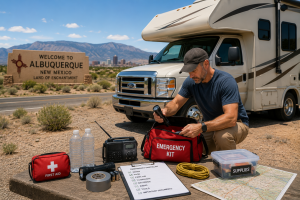
The goal of a good RV emergency checklist isn’t to cover every conceivable scenario — it’s to make sure the most likely problems don’t catch you completely flat-footed. Here’s what should be covered before you roll into New Mexico:
- Roadside emergency kit: jumper cables, reflective triangles or flares, tow strap, basic hand tools, tire plug kit, quality inflated spare
- Fire extinguisher — charged and accessible, not buried in a storage bay
- Smoke and carbon monoxide detectors with fresh batteries
- Physical maps of New Mexico and the Albuquerque region — GPS fails in remote areas
- At least five gallons of extra water stored in the rig — more in summer
- Three to five days of non-perishable food
- Battery-powered or hand-crank weather radio
- Portable jump starter (lithium battery type — far more reliable than carrying cables alone)
- Written emergency contacts, insurance info, and medical information
- Flashlights, headlamps, and backup batteries or charging bank
The water piece deserves emphasis. The high desert is deceptively dehydrating. You don’t sweat the way you do in humid climates, so you don’t always feel how much fluid you’re losing. Carry more water than you think you need, for both drinking and your RV systems.
If you’re still getting a feel for what traveling through this part of New Mexico involves, the Albuquerque area exploration and travel guide covers the region’s geography, points of interest, and local character in a way that helps you plan routes and understand what’s out there beyond the city itself.
Desert-Specific First Aid Essentials
Your standard first aid kit — bandages, antiseptic, pain relievers, tweezers — is a start. But desert travel adds a layer of specific risks that a basic kit doesn’t cover.
Heat and Sun
Heat exhaustion and heat stroke are real risks when temperatures climb and you’re doing even moderate outdoor activity. Your first aid kit should include electrolyte powder or tablets, aloe vera gel for sun and heat burns, and a spray bottle for quick cooling. Know the signs of heat exhaustion: heavy sweating, weakness, cool pale skin, nausea, and a fast weak pulse. Get the person into shade and start rehydrating immediately. Heat stroke — where the body stops sweating and temperature rises rapidly — is a medical emergency. Call 911 and start active cooling measures right away.
Dry Air and Altitude
Dry air at altitude causes faster dehydration, nosebleeds, and can worsen respiratory conditions. Saline nasal spray is genuinely useful. A small humidifier for overnight use helps with the adjustment, especially for the first couple of nights at elevation. Headaches and fatigue are common mild altitude responses — ibuprofen or aspirin and extra hydration usually handle it, but if symptoms are severe or include confusion, shortness of breath, or chest tightness, seek medical attention.
Wildlife and Vegetation
Rattlesnakes are present in the Albuquerque region, particularly in rocky and brushy terrain. They’re not aggressive, but they are well-camouflaged and startle defensively. Watch where you step and where you put your hands, especially around rocks and brush. Keep antihistamines in your kit for insect stings and plant contact. Cactus spines are not an emergency, but having tweezers and a magnifying glass makes the removal process considerably less miserable.
The RVing resources and visitor tips for Albuquerque covers a lot of practical on-the-ground information that helps travelers understand what to expect when they arrive — from campsite specifics to navigating the surrounding area safely.
Roadside RV Safety Tips for New Mexico Highways
New Mexico has some long, empty stretches of highway. I-40 east toward Tucumcari, I-25 south toward Truth or Consequences, US-60 heading toward Magdalena — these are beautiful drives that also have limited services and spotty cell coverage for significant stretches. Roadside safety in this context is a little different from breaking down near a Dallas suburb.
Pull as far off the road as physically possible before stopping. Reflective triangles should go out at 100, 200, and 300 feet behind the vehicle — further on highways with higher speed limits or limited visibility. Stay off the travel lanes entirely while waiting for assistance. This sounds obvious, but it’s worth saying plainly: on a desert highway with limited traffic, the impulse to stand near your rig and flag someone down is understandable, but the roadway itself is the most dangerous place to be.
Roadside assistance coverage is strongly recommended for any extended RV travel in New Mexico. Services like Good Sam, AAA, or Coach-Net can dispatch heavy-duty tow vehicles capable of handling an RV — which ordinary roadside assistance services often can’t. Make sure your plan specifically covers RVs, and have the number saved where you can find it without a signal (printed, not just on your phone).
Before heading out on longer day trips from Albuquerque, tell someone your route and expected return time. This is especially relevant for trips into less-traveled areas. If you don’t return on schedule, having someone who knows where to direct search and rescue is not a dramatic precaution — it’s just sensible.
Weather Emergencies: Flash Floods and Dust Storms
Two weather scenarios deserve specific attention for anyone traveling near Albuquerque during certain seasons.
Flash Floods
Monsoon storms in July through September can drop heavy rain in the mountains that flows into arroyos and dry washes miles away from where it rained. The wash you parked next to in the morning can have fast-moving water in it by early afternoon — even if it didn’t rain anywhere near you. Never camp in or near dry wash beds during monsoon season. Never attempt to drive through flooded road crossings. The New Mexico rule is the same one they say everywhere in the Southwest: turn around, don’t drown. Moving water is deceptivly strong and has swept vehicles far heavier than an RV off roads.
Dust Storms
Haboobs — large dust walls driven by storm outflow — can reduce visibility to near zero within minutes. If you see a wall of brown approaching while driving, pull completely off the road before the dust reaches you. Turn off your lights so other drivers don’t follow your tail lights into the median (a common accident pattern in dust storms). Turn off the engine and wait it out. Most dust storms pass relatively quickly, but trying to drive through one is genuinely dangerous.
Pre-Trip RV System Checks for Desert Travel
The desert is hard on equipment. Heat, UV radiation, and altitude all take a toll on systems that might have been fine in a more temperate environment. Before arriving in Albuquerque, run through these:
- Tire pressure and condition — heat expands air pressure significantly, and sidewall cracks become blowouts faster in desert conditions
- Coolant levels and radiator condition — overheating risk increases at altitude and in high ambient temperatures
- Air conditioning — this is life-safety equipment in a summer desert environment, not a comfort accessory
- Roof seals — UV exposure degrades sealants faster than in cooler climates; check for cracks before the monsoon season arrives
- Water system — if your rig has been sitting, flush and sanitize before you travel
- Battery charge and condition — temperature extremes accelerate battery degradation
The team at Albuquerque RV Park is a genuinely useful resource when you have questions about arriving and setting up — they know the local conditions and can point you in the right direction for services and local support if something needs attention after you arrive.
Settling In Smart at Albuquerque RV Park
Being prepared doesn’t mean being anxious. Most RV trips to Albuquerque go smoothly, and this city has a lot to offer — the Old Town, the Balloon Fiesta, the Petroglyph National Monument, the food scene that doesn’t get nearly enough credit. The preparation is what lets you actually enjoy all of that without the low-grade worry of wondering what happens if something goes sideways.
For more on what daily life looks like in the Albuquerque area and what makes it such a compelling place to stay for an extended time, the local lifestyle and Albuquerque living guide is worth reading before you arrive. And when you’re ready to plan your stay, Albuquerque RV Park offers a well-situated base for exploring one of the Southwest’s most interesting cities.
Prepare well, and Albuquerque delivers. It really does.
Frequently Asked Questions
What are the biggest safety risks for RV travelers near Albuquerque?
The primary environmental risks specific to this region are heat and dehydration, altitude adjustment, flash flooding during monsoon season (July through September), dust storms that reduce driving visibility, and extreme temperature swings between day and night. For roadside emergencies, the main concern is the remoteness of some New Mexico highways — long stretches with limited services and inconsistent cell coverage mean self-sufficiency and roadside assistance coverage matter more here than in more densely populated areas.
How much water should I carry in my RV when traveling through New Mexico?
A minimum of five gallons of stored drinking water beyond your normal fresh tank is a reasonable baseline — more in summer. The desert is dehydrating in ways that aren’t always obvious because dry air doesn’t produce the visible sweating that humid climates do. If you’re doing outdoor activities, camping in areas without hookups, or traveling routes with limited resupply points, increase that reserve accordingly. Water is the single most important supply item for desert RV travel and the easiest one to underestimate.
Is altitude a real concern for RV travelers in Albuquerque?
Yes, though most people adjust within a day or two without major issues. Albuquerque sits at approximately 5,300 feet, and the surrounding region goes higher. Mild symptoms like headache, fatigue, and shortness of breath during exertion are common for the first 24 to 48 hours. Staying well hydrated, avoiding alcohol on the first night, and taking it easy on arrival day helps significantly. For travelers with heart or lung conditions, consulting a physician before visiting high-altitude destinations is advisable. Severe symptoms — confusion, inability to walk, persistent chest tightness — warrant medical attention.
What should I do if I get caught in a dust storm while driving my RV?
Pull completely off the road before the storm reaches you — not just to the shoulder, but as far from the travel lanes as possible. Turn off your headlights and running lights so other drivers don’t follow your lights into traffic. Apply your parking brake, leave your foot off the brake so brake lights don’t create the same problem, and wait for the storm to pass. Most haboobs are intense but relatively brief. Attempting to drive through a dust storm with near-zero visibility is genuinely dangerous regardless of your vehicle’s size.
When is monsoon season in Albuquerque and what should RV travelers know?
Monsoon season in Albuquerque typically runs from approximately July through mid-September. Storms usually develop in the afternoon and can move quickly, bringing heavy localized rain, lightning, and flash flooding in low-lying areas and dry washes. The morning is usually clear, making it a better window for outdoor activity and driving in unfamiliar areas. Check the National Weather Service forecast each morning during this season and be particularly cautious about camping near or crossing dry arroyos — runoff from distant storms can fill them unexpectedly.
Do I need roadside assistance coverage for RV travel in New Mexico?
It’s strongly recommended. New Mexico has significant stretches of highway with limited services and variable cell coverage. Standard roadside assistance plans often don’t cover vehicles the size of towable or motorized RVs — you need a plan specifically designed for RVs that can dispatch heavy-duty tow equipment. Good Sam Roadside Assistance, AAA with RV coverage, and Coach-Net are the most common options. Have the contact number saved in a printed format, not just on your phone — the scenarios where you most need roadside assistance are often the same ones where your phone battery or signal is the least reliable.
What’s the closest hospital to Albuquerque RV Park?
Albuquerque is a mid-size city with good hospital infrastructure. Presbyterian Hospital and University of New Mexico Hospital are the main full-service hospital systems in the city, with multiple locations and affiliated urgent care clinics throughout the metro area. For non-emergency situations, urgent care centers are distributed across Albuquerque and offer faster service than emergency departments for minor injuries, illness, and basic medical needs. Having the address and phone number of the nearest urgent care to your campsite saved before you need it is a simple step that saves time and stress during an already stressful situation.