A monthly stay at 6,382 feet isn’t the same as one in Texas. Here’s what the park publishes, a promotion that excludes November move-ins, the weekly-vs-monthly math, and the winter questions to ask before you sign.
Committing to a monthly RV site at 6,382 feet in November isn’t the same as committing to one in Texas. The nights are colder, the air is drier, the road in and out of the canyon can ice and the winter is longer than the brochure suggests. It’s also a good deal for the right person: a mountain setting, a quiet community, a rate that includes electricity and a park on the old Route 66 corridor. The trick is to ask the questions that turn a good-looking page into a decision you won’t regret. Here are the questions to ask before committing to a monthly stay near Albuquerque, with what the park publishes and what it doesn’t.
What the Park Publishes
The park’s pricing page, last updated in November 2025, lists $50 a night, $195 a week and $630 a month, all with 30/50-amp power and full hookups including water, sewer and trash. The monthly rate is listed as including electric. The weekly and nightly rows don’t mention electric either way, so ask. Its long-term living page lists expansive lots, pull-through sites, 30/50-amp hookups, laundry open at any time, showers and restrooms, a playground, clubhouse, picnic areas, basketball court, dog park and nearby hiking trails. The park’s address is 844-B New Mexico 333 in Tijeras.
The Discount That Doesn’t Apply in November
Read the fine print on the promotion. The pricing page’s popup advertises $200 off the first month for a new customer, with the conditions that you must move in during December, January or February and commit to a minimum stay of three months. So if you’re moving in this month, you don’t qualify, and a move-in on December 1 would. That’s a $200 difference, or about a third of the monthly rate, which is worth a conversation. Ask whether the offer can apply to a November arrival, and what happens if your plans are shorter than three months. I’d also ask whether the three-month minimum applies to the monthly rate generally, or only to the promotion.
Weekly vs. Monthly: The Arithmetic
| Stay | Weekly rate total ($195/week) | Monthly rate ($630, electric included) |
|---|---|---|
| 1 week | $195 | $630 |
| 2 weeks | $390 | $630 |
| 3 weeks | $585 | $630 |
| 4 weeks | $780 | $630 |
That’s my arithmetic from the published rates. It says the monthly rate becomes the cheaper choice at about three and a quarter weeks, since $630 divided by $195 is about 3.2. Under that, weekly is cheaper, if the weekly rate includes electric, which is the thing to confirm. A 30-night stay at the nightly rate would be $1,500. And if you qualify for the winter promotion, your first month would be about $430, though I’d get that in writing.
Altitude and Cold: Ask About the Winter
The park’s guide to first cold nights and freeze risk puts Tijeras at 6,382 feet and estimates it runs about 3 to 4°F colder than Albuquerque on a comparable night, with winter nights commonly below freezing. That affects a monthly stay in practical ways. Your water hose will freeze, your furnace will run more and your propane use will climb. Ask what the park does about water in a freeze, whether sites have frost-protected spigots and whether it can tell you about the winter experience of long-term guests. I couldn’t find a published winter water policy.
Heat, Propane and the Electric Included
Because electric is included at $630, electric heat is, in effect, free at the margin, which changes how you can heat. Ask whether the park limits electric use, such as space heaters, on monthly stays, and whether there’s any cap. A space heater uses about 1,500 watts, and Camping World notes a 30-amp service supports about 3,600 watts, so you can only run so much at once. Also ask about propane: whether the park sells or refills it, and where the nearest refill is. I couldn’t find that published.
Dry Air and Moisture
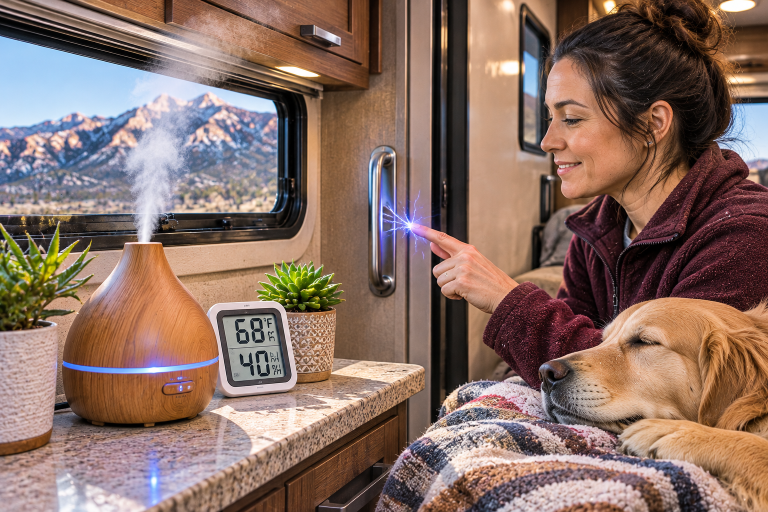
High-desert winters are dry, and a rig is small. You may find static, dry skin and nosebleeds, which we’ve covered in our post on dry air, and the opposite problem on the coldest nights, window condensation. The EPA’s guide to mold and moisture recommends keeping indoor humidity below 60 percent, ideally 30 to 50 percent. Bring a hygrometer. A month in a closed rig is long enough for moisture problems to show up.
Roads, Snow and Getting Out
Tijeras gets snow, and the East Mountains aren’t the valley. Interstate 40 runs through the canyon, and NM-333 is the old highway beside it. Ask where the park’s roads are plowed, who plows, and how it handles ice, since I couldn’t find a published policy. Check road conditions before any trip with the state’s NMRoads site. Keep a winter kit in your vehicle: blankets, water, a shovel, a flashlight and traction aids.
Questions About the Agreement
Get the agreement in writing, and read it. What is the term, and how does month-to-month renewal work? What’s the notice to leave? Is there a deposit, and how is it returned? What are the late fees? Does the rate change after the first month or the first season? What are the rules on guests, pets and vehicles? Are there restrictions on the age or condition of the rig? Can you leave the RV for a few days, for example for a trip? And is there a rule about how long a rig can stay, such as an annual limit? These are the things a nice-looking page doesn’t say.
Day-to-Day Life
Ask what daily life looks like. The long-term page mentions laundry, a clubhouse, a playground and a dog park. Ask how busy the laundry is and when. Ask whether the clubhouse is open in winter. Ask about mail and packages, since I don’t know whether the park accepts them. Ask about Wi-Fi if you work from your rig, since the pricing page doesn’t mention it. The park’s hours are Monday to Friday 8 a.m. to 6 p.m., Saturday 10 a.m. to 2 p.m. and Sunday 8 a.m. to 2 p.m., with a note to contact management for arrivals outside those hours.
Visit First, If You Can
The best test is a visit. A week at the weekly rate lets you see the site, the neighbors and the cold before you sign for a month. Walk the park in the morning and the evening. Talk to a long-term resident if you can. Look at the roads, the spigots and the place you’d park. The park doesn’t publish a visitor tour policy that I could find, so ask whether you can walk the property before you decide. You can reach the team at (505) 281-3363 or through the park’s contact page.
Three Sample Stays
Here are three illustrations from the published rates. For a 10-day visit, one week at $195 plus three nights at $50 is $345, well under the $630 monthly rate. For 21 days, three weeks at $195 is $585, which is $45 under the monthly rate. For 24 days, three weeks plus three nights comes to $735, which is $105 more than the monthly rate, so monthly wins. The crossover is somewhere between three and three and a half weeks, so if you’re unsure how long you’ll stay, the weekly rate gives you room to find out. These assume the weekly and nightly rates include electric, which the page doesn’t state, so confirm before you rely on the numbers.
Who a Mountain Month Suits
A month at 6,382 feet suits someone who likes quiet, doesn’t mind cold nights and wants to be near both the city and the trails. It suits a remote worker with a good internet plan, a traveler waiting out a longer project or a retiree wintering somewhere with real seasons. It suits less well someone who needs warm winters, a flat commute or a busy social calendar. Be honest about which one you are before you sign, and ask the office whether the park has a quiet period you could test before committing.
A Short Checklist
Confirm whether weekly includes electric. Ask whether the winter promotion can apply to a November arrival. Find out the minimum stay. Ask about winter water, plowing and propane. Check the rules on heaters and guests. Get the agreement in writing. Visit, if you can. And decide whether you want a month or a season, since the cold is the main thing a first-timer underestimates.
Ask about winter before you ask about price. A cheap rate doesn’t help if your water line is frozen.
Rates (pricing page, Nov 2025): $50 a night; $195 a week; $630 a month with electric included; 30/50 amp; water, sewer, trash.
Break-even: monthly is cheaper from about 3.2 weeks (if weekly includes electric).
Promotion: $200 off the first month for move-ins in Dec, Jan or Feb, new customers, 3-month minimum; not for a November move-in.
Elevation (park guide): 6,382 ft; about 3-4°F colder than Albuquerque; nights commonly below freezing.
Not published: winter water policy, plowing, propane service, Wi-Fi, minimum stay for the monthly rate.
For an East Mountains base where you can ask these questions before you commit, Albuquerque RV Park is where to start.
Frequently Asked Questions
How much is a monthly RV site near Albuquerque?
The park’s pricing page, updated November 2025, lists $630 a month including water, sewer, trash and electric, with 30/50-amp power. Weekly is $195 and nightly $50.
Is electric included?
The monthly rate is listed as including electric. The nightly and weekly rows don’t say, so ask.
Is there a discount for new monthly residents?
A popup offers $200 off the first month for move-ins in December, January or February, with a three-month minimum stay and new customers only. It doesn’t apply to a November move-in.
When is monthly cheaper than weekly?
By my arithmetic, from about three and a quarter weeks: $630 divided by $195 is about 3.2 weeks.
How cold does it get?
The park’s guide puts Tijeras at 6,382 feet, about 3 to 4°F colder than Albuquerque on a comparable night, with winter nights commonly below freezing.
What should I ask about winter?
Water in a freeze, plowing, propane refills, heater rules and what long-term residents experience. I couldn’t find these published.