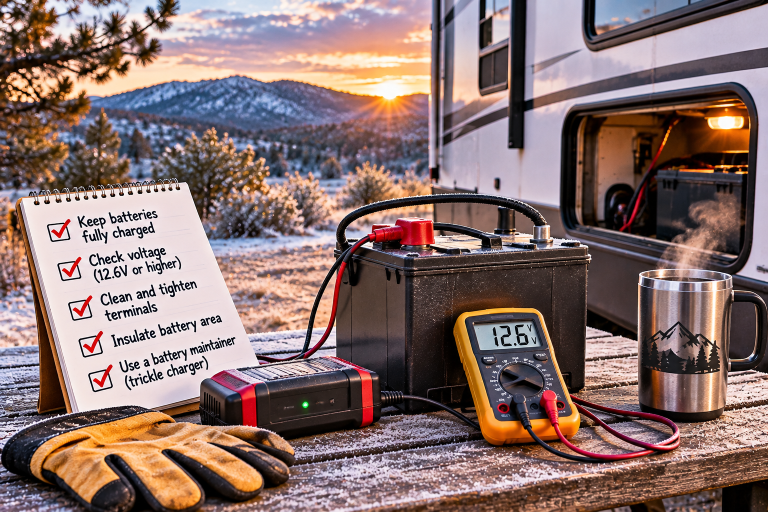
Campground water wasn’t designed with your RV’s plumbing in mind. A small brass regulator prevents a lot of damage. Here’s how to choose, place, set and test one, and how to protect it on a cold mountain night.
Full-hookup sites are one of the great conveniences of RV life. You pull in, connect the water, and have something close to a house. The part people forget is that a campground’s water system wasn’t designed with your RV in mind. Municipal and park water can arrive at a much higher pressure than your plumbing is built for, and the result is a slow leak behind a wall, a cracked fitting under the sink, or a water heater that vents at 2 a.m. A small brass fitting costs less than a tank of fuel and prevents all of it. Here’s how to choose, set up and test a regulator, with a few notes for Tijeras.
Why RV Plumbing Needs Protection
Most RV plumbing uses lightweight plastic fittings and flexible lines, and the weak points are often the fittings and hoses, not the pipes themselves. Winnebago, a major manufacturer, says that because city water pressure varies from location to location, it recommends an in-line regulator to prevent damage to any components, connections and seals in your fresh water system, and that it recommends regulators that control pressure to 50 psi. In its test of regulators, it used a spigot reading well above that as the example of one that would cause problems with an RV’s plumbing if connected directly.
Camping World’s guide puts the risk plainly: if the water pressure is too high, it can lead to broken lines or fittings that cause leaks and water damage, so you should install a regulator every time you connect to city water. It describes the typical safe setting as roughly 40 to 55 psi. Other guides report that campground pressure can run well above that, and members of one RV forum report seeing spikes above 100 psi at some parks, though that’s anecdote, not a measurement of any particular park.
What the Park Says About Its Water
Here’s the honest picture for Tijeras. The park’s RV sites and amenities page lists full hookups, with 30- and 50-amp power, pull-through sites and large lots. It doesn’t publish the water pressure at the pedestals, and I couldn’t find a figure anywhere else. So I can’t tell you what your site delivers. That’s exactly why you should assume nothing, measure it, and use a regulator every time.
Fixed or Adjustable?
There are two main types. A fixed regulator is preset, often to around 40 to 50 psi, and you simply attach it. The popular Camco brass model is described in listings as reducing pressure to a safe and consistent 40 to 50 psi. An adjustable regulator lets you dial in the pressure, usually with a screw or knob, and often has a built-in gauge. Camping World notes the advantage: an adjustable regulator lets you dial in the best pressure for conservation and for appliances like a tankless water heater that need a minimum flow to turn on.
| Fixed | Adjustable with gauge | |
|---|---|---|
| Setup | Attach and go | Attach, read the gauge, adjust |
| Flexibility | None; a preset number | Dial to your rig’s needs |
| Weak points | Can reduce flow when park pressure is low | Gauge can be inaccurate; adjustment can drift |
| Good for | Simple, reliable protection | Rigs with tankless heaters, varied parks |
One more point worth knowing: a regulator can only reduce pressure. A listing for one popular adjustable model notes you can’t increase the water pressure above the pressure of the source. If a park’s pressure is low, a regulator won’t fix that.
Where It Goes
The correct place is at the spigot. Camping World recommends screwing the regulator directly onto the city water spigot, then attaching a water filter to the regulator, then a drinking-water hose to the filter and on to the RV. That order protects the hose, which is also part of the system, along with everything beyond it. Always use a drinking-water-safe hose rather than a garden hose, and turn the water on slowly.
How to Test the Pressure
A gauge is cheap and tells you what you’re dealing with. Connect the regulator and hose, open a faucet briefly to purge air, close it, and read the gauge. You want the static pressure, with water not flowing, because the reading drops while water runs. A common target is around 50 psi, and some guides say a safe range is 40 to 55 psi. Check the owner’s manual for your rig’s maximum, since older rigs may prefer the low end. If you’re using a fixed regulator and want to know what the park delivers, a simple gauge at the spigot, before the regulator, will tell you the incoming pressure.
Setting It: The Sweet Spot
Higher isn’t better. At around 50 psi, a shower works well and plumbing is within its design range. Too low, and a tankless water heater may not fire, because it needs a minimum flow. Too high, and you stress fittings and seals. If your rig has a tankless water heater, test it at the setting you choose, and adjust a few psi up or down until it works consistently. Write the number on the regulator or in your notes so you can return to it at the next park.
Cold Nights in Tijeras
A regulator is a small brass body full of water, and in a hard freeze, it can crack. The park’s own guide to first cold nights and freeze risk puts Tijeras at 6,382 feet and estimates it runs about 3 to 4°F colder than Albuquerque on a comparable night. On nights forecast to dip below freezing, disconnect the hose, remove the regulator and filter, drain them and bring them inside, and don’t leave them on the spigot. The same applies to a heated hose: it protects the hose, not the spigot or the regulator. You can ask the office how the site hydrants are protected, and check the park rules for anything that affects your setup.
When You’re Not Sure About the Pressure
If the pressure at a site seems odd, or you don’t trust your regulator, there’s a simple fallback. Fill your fresh water tank, disconnect from city water and run on your own pump. Camping World’s winter guide recommends connecting the hose only when filling the fresh tank in freezing weather, and disconnecting it when you’re done. The pump runs at its own pressure, which is usually in a safe range for the plumbing, so it’s a good way to protect the rig until you’ve checked the pressure or replaced the regulator.
Common Mistakes
A few errors come up again and again. Putting the regulator on the RV end of the hose instead of at the spigot leaves the hose exposed to full pressure. Using a garden hose instead of a drinking-water-safe one is a health issue. Reading the gauge while water is running gives a number that’s lower than the real static pressure. Leaving the regulator on through a freeze can crack it. And assuming a new park has the same pressure as the last one is how rigs get damaged. A habit of checking each time, in the same order, avoids all of them.
Maintenance That Takes Five Minutes
A regulator is a wearing part. Flush it and check the inlet screen at the start of the season, since debris can clog the screen and reduce flow, and replace the regulator if it’s damaged, leaks, or gives inconsistent readings. If your gauge reads high or low compared with a second gauge, believe the one you trust. Keep a spare in the rig, since a failed regulator on a Friday night in a park far from a store is an easy problem to prevent.
Signs Something Is Wrong
Watch for a few symptoms. A hissing or dripping at a fitting, a water heater relief valve that opens when you’re not heating, a faucet that spits and sputters, or a fresh damp spot under a sink can all point to excess pressure or a failing part. Turn off the water at the spigot first, then investigate. And if you find water where it shouldn’t be, shut the supply and dry it quickly, because a slow leak behind a panel is easy to miss.
Regulator on first, water on second. Make it a habit before the hose touches the spigot, and write your setting down.
Target: around 50 psi (Winnebago); about 40-55 psi (Camping World); check your manual.
Order: spigot, regulator, filter, drinking-water hose, RV; use a regulator every time.
Test: read static pressure (water not running); adjustable models can be dialed in.
Park: full hookups, 30/50 amp; water pressure not published, so measure.
Cold: remove and drain the regulator and hose in a freeze; a heated hose doesn’t protect the spigot.
For full-hookup sites in the East Mountains, Albuquerque RV Park is where to start.
Frequently Asked Questions
Do I need a water pressure regulator at a full-hookup site?
Yes. Park pressure varies, and RV plumbing is built for much less than some parks deliver. Winnebago and Camping World both recommend using a regulator every time you connect to city water.
What pressure should I set my RV regulator to?
Around 50 psi is a common target. Winnebago recommends regulators that control pressure to 50 psi, and Camping World describes roughly 40 to 55 psi as typical. Check your owner’s manual.
What does the park’s water pressure measure?
The park doesn’t publish it, so I can’t say. Measure it with a gauge at the spigot, and use a regulator.
Should I use a fixed or adjustable regulator?
A fixed one is simple and reliable. An adjustable one with a gauge lets you tune pressure and check what you’re getting, which can matter with a tankless water heater.
How do I test water pressure at a campsite?
Connect the regulator and hose, open a faucet briefly to purge air, close it, and read the gauge. Use the static reading, not the reading while water runs.
Can a regulator freeze?
Yes. In a hard freeze, remove it and the hose, drain them and bring them inside. A heated hose protects the hose, not the spigot or regulator.