
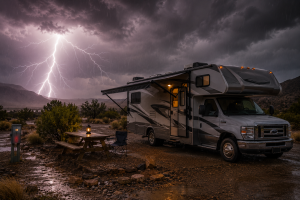
New Mexico’s summer monsoon season brings some of the most reliably dramatic afternoon thunderstorms in the country — and along with the dramatic skies and the relief from weeks of dry heat, the monsoon brings genuine lightning risk that RV campers specifically need to understand. This isn’t an abstract concern. New Mexico has one of the higher lightning fatality rates per capita in the United States, a fact tied directly to the state’s elevation, its outdoor recreation culture, and the monsoon pattern itself.
The North American Monsoon brings New Mexico’s characteristic summer weather pattern — clear mornings giving way to building afternoon cumulus clouds and, by mid-to-late afternoon, thunderstorms that can develop with real speed, particularly in the mountains and higher-elevation terrain around Albuquerque and the East Mountains. Understanding both the genuine risk this pattern presents and the specific, practical safety rules that apply to RV campers is essential for anyone spending a New Mexico summer outdoors.
Why New Mexico Carries Real Lightning Risk
New Mexico’s elevation is a significant factor in its lightning exposure. Higher elevation terrain — including the Sandia and Manzano Mountains east of Albuquerque — experiences more frequent and more intense thunderstorm activity than lower-elevation desert terrain, both because of the mountain-driven convective processes that build monsoon thunderstorms and because higher terrain places people physically closer to the storm activity itself. The state’s strong outdoor recreation culture, with large numbers of people hiking, camping, and RVing during exactly the summer months when monsoon activity peaks, compounds the exposure.
The monsoon season in New Mexico typically runs from early July through mid-September, with the most reliable afternoon thunderstorm development occurring during this window. Storms in this pattern tend to build over higher terrain first, then move across lower elevations as they mature — meaning a completely clear sky over your RV site doesn’t guarantee you’re safe from a storm that’s actively developing in visible mountains nearby and moving in your direction.
“The New Mexico monsoon storm that builds over the Sandias at two in the afternoon can be over your campsite by three-thirty. People who’ve spent a summer here learn to watch the western and southwestern sky specifically, because that’s usually where the afternoon development starts.”
Is an RV Safe During a Lightning Storm?
This is the single most important practical question for RV campers, and the answer requires some nuance. A hard-sided RV with a metal frame or significant metal content in its construction can provide a degree of protection similar to the “cage” effect of a metal-topped vehicle — if lightning strikes the RV directly, the electrical charge is more likely to travel along the exterior metal structure and through to the ground rather than through the interior and the people inside, provided you’re not touching anything connected to the RV’s metal frame, plumbing, or electrical systems during the strike.
This protection is meaningfully different from a soft-sided tent, a pop-up camper with canvas sides, or standing outside near your RV, all of which offer essentially no protection from a direct or nearby lightning strike. However, an RV is not equivalent to a permanent building with grounded wiring and plumbing specifically designed for this purpose, and RV manufacturers and safety organizations don’t market RVs as certified “lightning-safe shelters” in the way a properly grounded house is understood to be.
What This Means Practically
During a thunderstorm, staying inside your RV is meaningfully safer than being outside, under an awning, in an open-air pavilion, or near tall isolated objects like trees. Avoid touching the RV’s metal frame, plumbing fixtures, or plugged-in electrical appliances and outlets during active lightning in your immediate area, since a direct or nearby strike can travel along these conductive pathways. Disconnect from shore power if a storm is approaching and lightning risk is elevated, both to protect your electrical systems from a potential power surge and to reduce a conductive pathway into the RV’s interior systems. Avoid using plumbing (sinks, showers) during an active storm directly overhead, since metal plumbing can conduct a strike’s electrical charge.
What to Do If You’re Outside When a Storm Develops
If you’re outside your RV — hiking, at a nearby trail, or simply out at the campsite — when a thunderstorm develops, the standard lightning safety guidance applies: get to a hard-sided vehicle or a substantial building as quickly as possible. If neither is available, avoid open fields, ridgelines, isolated tall trees, and elevated terrain, all of which increase your relative exposure to a strike. Avoid being the tallest object in an open area, and avoid standing in groups spread across open terrain, since this increases the total area at risk from a single nearby strike.
The “30-30 rule” is a widely used practical guideline: if the time between seeing lightning and hearing the resulting thunder is 30 seconds or less, the storm is within roughly 6 miles and close enough to pose a real risk — seek shelter immediately. After the last thunderclap, wait at least 30 minutes before resuming outdoor activity, since lightning can strike from a storm cell that appears to have passed, sometimes referred to as a “bolt from the blue” striking many miles from the storm’s visible center.
Awning and Outdoor Equipment Safety
Retract your RV awning before a thunderstorm arrives — beyond the wind damage risk that awnings face in any strong storm, a metal awning frame extended from the RV in an open, elevated position adds an additional tall conductive element near your campsite during active lightning. Bring in or secure any other metal camping equipment, tent poles, or similar tall or conductive items rather than leaving them set up during an approaching storm. If you’re using a portable canopy or pavilion structure, this offers no lightning protection at all and should be vacated in favor of your RV or a substantial building well before a storm arrives.
Monitoring Monsoon Storms Proactively
Given how quickly New Mexico monsoon storms can develop, particularly over the mountains east of Albuquerque, proactive monitoring during the July through September monsoon window is more effective than reactive response once a storm is already visible. Checking the National Weather Service forecast (weather.gov) each morning during monsoon season, watching the western and southwestern sky during afternoon hours specifically for building cumulus development, and having a weather alert app or NOAA Weather Radio active during outdoor activities all give meaningfully more lead time than waiting to notice an approaching storm visually.
Monsoon season: early July through mid-September. Afternoon thunderstorm development typical, often building over mountains first (Sandias, Manzanos) then moving to lower terrain.
RV shelter: hard-sided RV offers meaningful protection if you avoid touching metal frame, plumbing, and plugged-in electronics during a strike. Not equivalent to a grounded permanent building, but far safer than being outside or in a tent.
30-30 rule: 30 seconds or less between lightning flash and thunder = storm within ~6 miles, seek shelter immediately. Wait 30 minutes after the last thunderclap before resuming outdoor activity.
Before a storm arrives: retract the awning, disconnect from shore power if lightning risk is elevated, bring in metal camping equipment, avoid plumbing use during an overhead storm.
If outside: avoid open fields, ridgelines, isolated tall trees, and being the tallest object in open terrain. Get to a hard-sided vehicle or substantial building.
Monitor: weather.gov daily during monsoon season. Watch western/southwestern sky in afternoon. Use a weather alert app or NOAA Weather Radio.
For guests planning a New Mexico summer stay who want the broader picture of monsoon season and outdoor activity timing, the Albuquerque and East Mountains exploration guide covers seasonal activity planning beyond just safety considerations. The New Mexico RV travel and planning guide gives the broader regional travel context for a summer visit. For travelers approaching from the Los Lunas, NM area to the south, the RV park in Los Lunas, NM page covers that corridor. And for booking any New Mexico summer stay, Albuquerque RV Park is the starting point.
Frequently Asked Questions
Is it safe to stay inside my RV during a lightning storm?
A hard-sided RV with metal frame construction provides meaningful protection during a lightning storm, functioning somewhat like the protective “cage” effect of a metal-roofed vehicle — if the RV is struck, the charge is more likely to travel along the exterior structure to the ground rather than through the interior, provided you avoid touching the RV’s metal frame, plumbing fixtures, and plugged-in electrical devices during the strike. This is meaningfully safer than being outside, in a tent, or under an open awning or pavilion. However, an RV is not equivalent to a permanent, properly grounded building, so staying inside and avoiding conductive surfaces during an active storm is the appropriate precaution rather than assuming complete protection.
When is monsoon season in New Mexico?
The North American Monsoon typically affects New Mexico from early July through mid-September, bringing a characteristic pattern of clear mornings followed by building afternoon cumulus clouds and thunderstorm development, often beginning over higher-elevation terrain like the Sandia and Manzano Mountains before moving to lower elevations as storms mature. This period produces the most reliable afternoon thunderstorm activity of the year in the Albuquerque and East Mountains region, along with the associated lightning risk that campers and outdoor recreationists need to plan around during these months.
What is the 30-30 rule for lightning safety?
The 30-30 rule is a widely used practical lightning safety guideline: if the time between seeing a lightning flash and hearing the resulting thunder is 30 seconds or less, the storm is within approximately 6 miles and close enough to pose a genuine risk, meaning you should seek shelter immediately. After the last audible thunderclap, the guideline recommends waiting at least 30 minutes before resuming outdoor activity, since lightning can strike from a storm that appears to have moved past, sometimes striking many miles from the visible storm center. This rule applies to RV campers just as it does to hikers and anyone else outdoors during thunderstorm conditions.
Should I retract my RV awning before a New Mexico thunderstorm?
Yes. Beyond the wind damage risk that RV awnings face during any strong thunderstorm, a metal awning frame extended from the RV in an open, elevated position adds an additional tall conductive element near your campsite during active lightning. Retracting the awning before a storm arrives addresses both the wind safety concern and reduces potential lightning exposure. Similarly, any other metal camping equipment, tent poles, or tall conductive items set up at your site should be brought in or secured rather than left standing during an approaching monsoon storm.
Why does New Mexico have such a high lightning risk?
New Mexico’s elevated terrain is a significant factor in its lightning exposure — higher-elevation areas, including the Sandia and Manzano Mountains, experience more frequent and intense thunderstorm activity than lower desert terrain, both due to the mountain-driven convective processes that build monsoon storms and because higher terrain places people physically closer to storm activity. The state’s strong outdoor recreation culture, combined with a large population hiking, camping, and RVing specifically during the summer monsoon months when thunderstorm activity peaks, further increases overall lightning exposure. This combination of terrain and outdoor activity timing contributes to New Mexico’s comparatively high lightning fatality rate per capita relative to many other US states.
Should I disconnect from shore power during a thunderstorm?
Yes, disconnecting from shore power when lightning risk is elevated in your immediate area is a reasonable precaution, both to protect your RV’s electrical systems from a potential power surge caused by a nearby strike and to reduce a conductive pathway into the RV’s interior systems. This should be done proactively before the storm arrives if possible, rather than during active lightning, since you want to avoid handling electrical connections while lightning risk is immediate. Monitoring the forecast and disconnecting during the early stages of an approaching storm, rather than waiting until it’s directly overhead, is the safer practical approach.