
Pecos National Historical Park sits at nearly 6,900 feet in the Upper Pecos Valley, which means it’s running noticeably cooler than Albuquerque on any given July afternoon — and it’s carrying 12,000 years of continuous human history across a landscape that includes an ancestral pueblo, a Spanish mission church, a Civil War battlefield, and a 20th-century dude ranch that once hosted a movie star. It’s free to enter, it’s about an hour and 40 minutes from the East Mountains, and it’s one of the more underrated day trips available to anyone staying near Tijeras or Albuquerque.
Why Pecos Is Cooler: The Elevation Advantage
Pecos National Historical Park sits at approximately 6,900 feet elevation — meaningfully higher than Albuquerque’s 5,312 feet, and even somewhat higher than the East Mountains communities of Tijeras (6,200 feet) and Cedar Crest (6,500 feet). Using the standard atmospheric lapse rate of roughly 3.5°F per 1,000 feet of elevation gain, Pecos runs approximately 3 to 5°F cooler than Albuquerque proper on a comparable July day, and the surrounding Sangre de Cristo foothill terrain provides tree cover and canyon shade that further moderates the felt temperature on the park’s trails.
The practical result: a July afternoon that would be uncomfortably hot for an extended outdoor walk in Albuquerque is genuinely pleasant at Pecos, particularly along the shaded portions of the trail system. This is the specific value proposition for East Mountains and Albuquerque residents looking for a summer day trip that doesn’t just relocate the heat problem — Pecos actually solves it, at least partially.
12,000 Years of History in One Park
The scope of human history preserved at Pecos is the park’s real distinction. Human presence in the area dates back roughly 12,000 years, and the site has continuously mattered to different peoples and empires across that entire span — Ancestral Puebloan farmers, the powerful Pecos Pueblo trading center, Spanish colonizers, Mexican-era travelers, Santa Fe Trail traders, Civil War soldiers, and 20th-century ranch owners have all left their mark on this same stretch of the Upper Pecos Valley.
Pecos Pueblo (Cicuye)
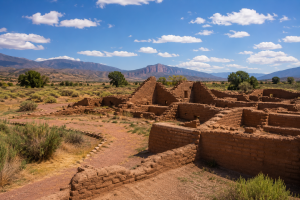
The Ancestral Sites Trail — a 1.25-mile self-guided loop starting behind the visitor center — takes you through the remains of Pecos Pueblo, known to its original inhabitants as Cicuye. At its height in the 15th and early 16th centuries, Pecos Pueblo was one of the largest and most powerful pueblos in the Southwest, a major trading hub between the Rio Grande pueblos to the west and the Plains tribes to the east. The multi-story adobe structure that once housed hundreds of residents is now preserved as a series of low walls and foundations that you walk through and around, with interpretive signage explaining what you’re looking at throughout the loop. Plan 45 minutes to an hour for the full loop at an unhurried pace.
The Spanish Mission Church
Adjacent to the pueblo ruins, the remains of a massive Spanish mission church — built in the early 17th century and rebuilt after being destroyed during the Pueblo Revolt of 1680 — stand as one of the most striking structures in the park. The adobe walls, though partially ruined, still convey the scale and ambition of the original mission complex, and the juxtaposition of the mission ruins directly beside the pueblo they were built to convert is one of the most historically loaded single views in New Mexico.
Glorieta Battlefield
The Glorieta Battlefield Trail, located about 7.5 miles from the main visitor center, preserves the site of the Battle of Glorieta Pass — an 1862 Civil War engagement often called “the Gettysburg of the West” because the Union victory here effectively ended Confederate ambitions to seize the New Mexico Territory and its access to Western gold fields and Pacific ports. The battlefield trail is a separate stop from the main pueblo site, and visitors with a strong interest in Civil War history should plan the additional drive time to include it.
Forked Lightning Ranch
The Forked Lightning Ranch, included within the park boundaries, was a 20th-century dude ranch with a notable Hollywood connection — it was once owned by E.E. “Buddy” Fogelson and his wife, Academy Award-winning actress Greer Garson. The ranch buildings and grounds are open on a more limited schedule than the main pueblo site; entrance hours vary seasonally, so calling the visitor center (505-757-7241) before planning a Forked Lightning visit specifically is the right move.
“What makes Pecos different from a lot of single-story historic sites is that you’re not just looking at one era. You’re standing where a pueblo trading empire, a Spanish mission, a Civil War battle, and a Hollywood-era dude ranch all happened on the same ground across twelve thousand years. It’s a genuinely layered place.”
Planning the Drive From the East Mountains
Pecos National Historical Park is located in Pecos, New Mexico, approximately 25 miles east of Santa Fe. From the East Mountains area (Tijeras, Cedar Crest, Edgewood), the most direct route is I-40 west to I-25 north through Santa Fe, then I-25 north to Exit 299 (Glorieta), following NM-50 to Pecos and NM-63 south to the park entrance. The total drive is approximately 75 to 85 miles and takes roughly 1 hour and 30 minutes to 1 hour and 45 minutes depending on the specific East Mountains starting point and traffic through the Santa Fe corridor.
This makes Pecos a comfortable day trip rather than a rushed one — leaving the East Mountains by 9 a.m. gets you to the park with the full day ahead, time for the pueblo loop, a stop at the visitor center, lunch, and the Glorieta Battlefield if that’s part of your plan, with a return drive that still gets you home at a reasonable hour.
Practical Visit Information for 2026
Pecos National Historical Park is open year-round with the exception of Thanksgiving Day, Christmas Day, and New Year’s Day. There is no fee to enter the park — a genuine rarity among National Park Service sites of this historical significance, and worth factoring into a summer travel budget where many other regional attractions carry admission costs.
The Ancestral Sites Trail and Glorieta Battlefield Trail are open 8 a.m. to 4:30 p.m. year-round. The Visitor Center and Western National Parks Store operate on seasonal hours — summer hours (May 3 through October 31, 2026) run 8:30 a.m. to 4 p.m. Entrance hours for the Forked Lightning Ranch, South Pasture Loop Trail, and Trading Post Exhibits vary seasonally; call the visitor center at 505-757-7241 for current details before planning a visit specifically around these secondary sites.
Camping is not permitted within the park itself. For visitors wanting to extend a Pecos visit into an overnight stay, campgrounds are available in the Santa Fe National Forest and at Pecos Canyon State Park, both located just north of the park on NM Highway 63 — though for East Mountains RV park guests, a day trip return is the more practical structure given the reasonable drive distance.
Location: Pecos, NM 87552. ~25 miles east of Santa Fe, ~75-85 miles from East Mountains area.
Admission: Free. No entrance fee.
Hours: Ancestral Sites Trail and Glorieta Battlefield Trail open 8 a.m.-4:30 p.m. year-round. Visitor Center summer hours (May 3-Oct 31, 2026): 8:30 a.m.-4 p.m.
Closed: Thanksgiving, Christmas, New Year’s Day only.
Elevation: ~6,900 ft — approximately 3-5°F cooler than Albuquerque on a comparable day.
Main sites: Pecos Pueblo (Cicuye) and Spanish Mission — 1.25-mi self-guided loop, 45 min-1 hr. Glorieta Battlefield Trail — 7.5 mi from visitor center, separate stop. Forked Lightning Ranch — seasonal hours, call ahead.
Contact: 505-757-7241 for current seasonal hours on secondary sites.
Camping: not permitted in park. Santa Fe National Forest and Pecos Canyon State Park campgrounds nearby on NM-63.
For the full picture of East Mountains and Albuquerque area day trips beyond Pecos, the Albuquerque and East Mountains exploration guide covers the broader regional activity calendar. The New Mexico RV travel and planning guide gives the routing context for a multi-stop New Mexico itinerary that includes Pecos, Santa Fe, and points beyond. For comparing East Mountains options against staying directly in Albuquerque for easier access to I-25 north, the RV park in Albuquerque, NM page gives that alternative. And for booking any East Mountains stay with Pecos and Santa Fe day trips in mind, Albuquerque RV Park is the starting point.
Frequently Asked Questions
How far is Pecos National Historical Park from Albuquerque?
Pecos National Historical Park is approximately 87 miles from Albuquerque, taking approximately 1 hour and 30 minutes via I-25 north through Santa Fe. From the East Mountains area (Tijeras, Cedar Crest, Edgewood), the drive is slightly shorter at approximately 75 to 85 miles, roughly 1 hour 30 minutes to 1 hour 45 minutes, using I-40 west to I-25 north and then Exit 299 (Glorieta) to NM-50 and NM-63. The park is closer to Santa Fe — approximately 25 miles east — for visitors approaching from that direction. There is no public transportation to the park; a personal vehicle is necessary as the park’s various sites are spread across a significant area.
Is there an entrance fee for Pecos National Historical Park?
No. Pecos National Historical Park has no entrance fee — admission is completely free for all visitors. This is notable given the park’s historical significance and 12,000 years of documented human history preserved on the site. The park is open year-round with the exception of Thanksgiving Day, Christmas Day, and New Year’s Day. The Ancestral Sites Trail and Glorieta Battlefield Trail are open 8 a.m. to 4:30 p.m. daily throughout the year, while the Visitor Center operates on seasonal hours (8:30 a.m. to 4 p.m. during summer months, May through October).
Is Pecos National Historical Park cooler than Albuquerque in summer?
Yes. Pecos National Historical Park sits at approximately 6,900 feet elevation, compared to Albuquerque’s 5,312 feet — a difference of roughly 1,600 feet that translates to approximately 3.5°F to 5.5°F cooler temperatures using the standard atmospheric lapse rate of about 3.5°F per 1,000 feet of elevation gain. The park’s location in the foothills of the Sangre de Cristo Mountains also provides tree cover and canyon shade along portions of the trail system that further moderate the felt temperature during a summer visit. This makes Pecos a genuinely cooler day-trip option for East Mountains and Albuquerque residents seeking relief from July and August heat, rather than simply relocating to a different hot location.
What is the main trail at Pecos National Historical Park?
The Ancestral Sites Trail is the main and most-visited trail at Pecos National Historical Park — a 1.25-mile self-guided loop that begins directly behind the visitor center and takes visitors through the preserved ruins of Pecos Pueblo (known to its original inhabitants as Cicuye) and the adjacent Spanish mission church ruins. The trail is well-marked with interpretive signage throughout, and most visitors plan 45 minutes to 1 hour to complete the loop at an unhurried pace. The separate Glorieta Battlefield Trail, located approximately 7.5 miles from the main visitor center, preserves the site of the 1862 Civil War Battle of Glorieta Pass and requires a separate drive and visit from the main pueblo site.
What is the Battle of Glorieta Pass and why is it significant?
The Battle of Glorieta Pass was an 1862 Civil War engagement fought within what is now Pecos National Historical Park, often referred to as “the Gettysburg of the West” due to its strategic significance. The Union victory at Glorieta Pass effectively ended Confederate ambitions to seize control of the New Mexico Territory, which would have given the Confederacy access to Western gold fields and potential Pacific coast ports. The Glorieta Battlefield Trail, located about 7.5 miles from the park’s main visitor center, preserves the battlefield site and includes interpretive information about the engagement. Visitors with a specific interest in Civil War history should plan for the additional drive time required to visit this separate section of the park.
Can you camp at Pecos National Historical Park?
No, camping is not permitted within Pecos National Historical Park itself. For visitors wanting to extend a visit into an overnight stay in the area, campgrounds are available in the adjacent Santa Fe National Forest (contact the Pecos District Ranger Station at 505-757-6121) and at Pecos Canyon State Park (28 Fish Hatchery Road, Pecos, NM, 505-670-8196), both located just north of the park on New Mexico Highway 63. For most visitors staying at an East Mountains or Albuquerque RV park, however, Pecos National Historical Park’s reasonable drive distance (75 to 90 minutes) makes a day trip the more practical structure rather than arranging separate overnight camping near the park.