One of New Mexico’s best drives starts practically in your backyard if you’re based in the East Mountains — and most people who’ve lived near Albuquerque for years haven’t made it yet.
From Tijeras or the Albuquerque East Mountains area, a Turquoise Trail day trip is one of those options that sits available and underused — the kind of thing people mean to do and then somehow keep not doing. This guide is for finally doing it.
What Is the Turquoise Trail?
The Turquoise Trail is the informal name for New Mexico State Route 14, a 62-mile scenic corridor that runs from Albuquerque’s eastern edge through the Sandia Mountain foothills, connecting the communities of Tijeras, Cedar Crest, Edgewood, Moriarty, and — most famously — Madrid and Cerrillos before arriving in Santa Fe.
The name comes from the region’s history as a pre-Columbian and early Spanish colonial turquoise mining area. The Cerrillos Hills southeast of Santa Fe were among the most productive turquoise sources in North America for centuries, and the trade routes that ran through this corridor long before European arrival eventually became the road that is now NM-14.
The designation as a National Scenic Byway is official — this is one of the recognized scenic drives near Albuquerque that appears in travel guides and on every New Mexico tourism resource. That recognition is earned. The combination of terrain, history, and cultural character makes this one of the genuinely distinctive drives in the Southwest.
The Drive from Tijeras
If you’re based in the Tijeras or East Mountains area, you’re starting from one of the best possible positions for this trip. Tijeras sits right at the junction of I-40 and NM-14, which means you’re essentially at the southern trailhead of the Turquoise Trail without any significant pre-drive required.
Heading north on NM-14 from Tijeras, the drive climbs through piñon-juniper woodland with the Sandia Mountains visible to the west and the Estancia Valley opening to the east. The first stretch through Cedar Crest and into the small communities along the route has the unhurried, rural character that makes this road feel like a different New Mexico from the interstate corridor just miles away.
The East Mountains attractions along this section include small galleries, orchards (particularly in fall when local apple and pear operations are active), and the natural beauty of the high desert foothills. You don’t need to stop for anything before Madrid if the day’s agenda is focused on the town itself — but Cedar Crest has enough small-town character that it’s worth a coffee stop on the way out or the way back.
“NM-14 through the East Mountains is the road that reminds you why people came to New Mexico in the first place — and then stayed.”
Madrid, NM: The Ghost Town That Came Back Different
Madrid (pronounced MAD-rid by locals — not Ma-DRID, a distinction locals make with quiet firmness) is the reason most people drive the Turquoise Trail. It’s a former coal mining town that had a population of nearly three thousand at its peak in the 1920s and essentially emptied out when coal production ended in the 1950s. By the 1970s, the abandoned company town was being sold off — entire houses for five hundred dollars — and attracted artists, craftspeople, and countercultural types who found the cheap space and remote beauty appealing.
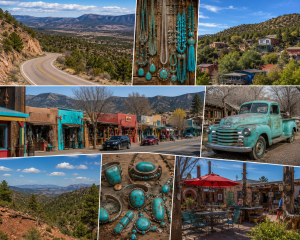
What they built over the following decades is one of the more genuinely interesting small communities in New Mexico: a one-street town whose entire Main Street is an uninterrupted row of art galleries, studios, antique shops, craft operations, and a handful of excellent food and drink options. The buildings are original — the old company housing and commercial structures from the mining era — which gives the town a visual coherence you can’t fake with new construction. Madrid looks like what it actually is, which is rare.
What to See and Do in Madrid
The galleries are the main draw. Most of them feature work by the artists who live in and around Madrid — paintings, sculpture, ceramics, photography, jewelry, and various forms of craft that don’t fit neatly into category. The quality is genuinely good; this isn’t a tourist trap gift shop situation. The concentration of working artists who actually live here keeps the work honest and interesting in a way that more commercially oriented art districts don’t always manage.
The Mine Shaft Tavern is the social center of Madrid and one of the best bars in New Mexico by most accounts. It occupies the old mine shaft building from the coal era and has a character that is specific to itself — weathered wood, vintage mining artifacts, a long bar, and live music on weekends that draws people from Albuquerque and Santa Fe specifically. The food is solid pub fare. The atmosphere is unlike anything you’d find in a city.
The Huber House is a small historic museum that gives context to the mining town history. The Madrid baseball field — which was once considered one of the most beautiful baseball parks in the Southwest, with games played under lights that attracted crowds from across New Mexico when the mines were operating — still exists and is visible from the road. The story of Madrid’s baseball program in its heyday is one of those New Mexico details that reveals how self-contained and vibrant the mining community was in its prime.
Cerrillos: The Quieter Stop on the Way Back
Continuing north from Madrid, the tiny village of Cerrillos is about fifteen minutes up the road and worth a brief stop. Even smaller and quieter than Madrid, Cerrillos has a classic New Mexico plaza surrounded by adobe buildings, a couple of small shops and galleries, and the Casa Grande Trading Post — an eclectic combination of turquoise mine tour, petting zoo, and antique operation that has been there for decades and represents the kind of idiosyncratic business model that only works in rural New Mexico.
The Cerrillos Hills State Park, adjacent to the village, offers short hiking trails through the historic mining landscape — a landscape of small hills, dry arroyos, and scattered remnants of centuries of mining activity. For the historically curious traveler, walking these trails while knowing they follow the same terrain that prehistoric Pueblo people and Spanish colonial miners worked is a genuinely resonant experience.
The Route 66 Connection
For RV travelers interested in historic American road culture, the Turquoise Trail intersects meaningfully with the Route 66 New Mexico story. I-40 follows the original Route 66 alignment through Tijeras Canyon, and the East Mountains area is part of the historic Route 66 corridor that ran from Chicago to Santa Monica through the American Southwest. Tijeras itself sits at this intersection — where the historic highway and the Turquoise Trail meet — which gives the day trip a layered American road history that goes well beyond the scenic byway designation.
For RV travelers tracing the Route 66 journey, the Turquoise Trail represents the kind of significant departure from the main road that rewards curiosity. The interstate follows the commerce corridor. NM-14 follows the landscape and history that existed before the commerce corridor arrived.
Practical Notes for the Day Trip
The drive from Tijeras to Madrid is about 35 miles and takes roughly 45 minutes without stops, but budget two to three hours for Madrid itself and another 30 to 45 minutes if you continue to Cerrillos. A round trip from Tijeras, with time in Madrid and Cerrillos and a meal at the Mine Shaft Tavern, fills a full day comfortably.
Madrid has no grocery store and limited services beyond the Main Street establishments. Bring water, particularly in summer. Parking on the main street is informal but generally workable — the town sees enough visitor traffic that overflow parking is available in several spots along the road. Weekends bring more people; weekday visits in spring and fall are the most relaxed.
Making the Most of Your East Mountains Base
The Turquoise Trail is just one of the options available to travelers based in the Tijeras and East Mountains area. The combination of quick I-40 access, the Sandia Mountain backdrop, and the proximity to both Albuquerque and Santa Fe makes this one of the most strategically positioned areas in New Mexico for exploratory day trips in multiple directions.
For travelers based at an Albuquerque-area RV park and looking for the full picture of what the region offers for day trips, exploration, and extended stays, the Albuquerque area exploration guide covers the broader range — not just the Turquoise Trail, but the full menu of what makes this part of New Mexico worth more than a single night.
For those new to the RV lifestyle or planning a first extended Southwest road trip, the RVing lifestyle and travel planning resource offers practical guidance on getting the most out of this kind of slow, exploratory travel. And for travelers thinking about what extended time in the Albuquerque area actually looks and feels like day to day, the community and lifestyle guide for the Albuquerque area gives a grounded, honest picture of the place beyond the tourist version.
The Turquoise Trail is a good starting point. But the area keeps giving long after the first scenic drive.
Frequently Asked Questions
How far is Madrid, NM from Tijeras?
Madrid is approximately 35 miles north of Tijeras via NM-14 (the Turquoise Trail). The drive takes about 45 minutes without stops, following NM-14 north through Cedar Crest and past the small communities along the route. The road is two-lane throughout and passes through scenic high desert foothills terrain — pace yourself and plan to enjoy the drive rather than covering the distance as quickly as possible.
Is Madrid, NM worth visiting?
Yes, genuinely. Madrid is one of the most distinctive small communities in New Mexico — a former coal mining ghost town that was rehabited by artists starting in the 1970s and has developed into a one-street concentration of working galleries, studios, and interesting food and drink options, all housed in original mining-era buildings. It’s not a manufactured tourist attraction but an actual community of working artists. The Mine Shaft Tavern alone is worth the drive for most visitors. Allow at least two to three hours if you want to walk the full main street and spend time in the galleries.
Can I drive the entire Turquoise Trail in a day?
Yes. The full Turquoise Trail from the southern trailhead near Tijeras to Santa Fe is 62 miles and takes about 90 minutes of driving time without stops. A day trip that starts in Tijeras, stops in Madrid for two to three hours, continues to Cerrillos for an hour, and then either turns around or continues to Santa Fe is entirely manageable as a day’s outing. The return trip from Santa Fe via I-25 south to I-40 east is faster than retracing NM-14 — about 65 miles on highway versus the 62-mile scenic route — making a loop possible if you want to avoid repeating the same road.
What is the history of Madrid, NM?
Madrid was established as a company coal mining town in the 1880s, reached its peak population of approximately 2,500 to 3,000 in the 1920s, and was essentially abandoned when the Albuquerque and Cerrillos Coal Company shut down operations in 1954. The town sat vacant for over a decade before Oscar Huber, who owned much of the property, began selling off houses and buildings in the late 1960s for nominal prices. Artists and countercultural residents began moving in during the 1970s, attracted by cheap space and the high-desert landscape. The community has grown gradually since then into the gallery-and-arts town it is today, while retaining much of the original mining-era architecture.
What should I eat in Madrid, NM?
The Mine Shaft Tavern is the primary dining and drinking destination in Madrid — a historic bar in the original mine shaft building with solid pub food, a distinctive atmosphere, and live music on weekends. The Hollar restaurant, also on Main Street, has a more extensive menu with New Mexican cuisine and is a popular lunch destination for day-trippers. Several of the smaller cafés and food operations along the main strip offer lighter fare, coffee, and snacks. Madrid is a small town, so the food options are limited — but what’s there is genuinely good, and the Mine Shaft Tavern in particular has a reputation that extends well beyond the town itself.
Is the Turquoise Trail accessible for large RVs?
NM-14 is a paved two-lane state highway that is generally accessible to most RV sizes, though it has curves and grades that require attentive driving. Large Class A motorhomes and fifth wheels are driven on the route regularly, but drivers should be aware that passing and turning opportunities are more limited than on a four-lane highway. Madrid’s main street has limited large-vehicle parking — most RV travelers to Madrid drive a tow vehicle or smaller vehicle rather than their full rig, or park at designated areas outside the main strip and walk in. The overall condition of the road is good and it is a legitimate scenic byway managed for public access.