
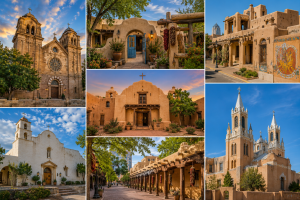
Albuquerque is one of the oldest continuously inhabited cities in the United States — and the buildings here know it. This is a place where architecture tells a story that goes back a very long way.
The historic architecture of Albuquerque reflects layer upon layer of culture — Tiwa-speaking Pueblo peoples, Spanish missionaries, Mexican settlers, Anglo-American settlers, and a 20th century that brought its own wave of artistic and architectural innovation. You can read all of that in stone and adobe if you know what you’re looking at.
This guide walks through the churches, landmarks, and architectural traditions that make Albuquerque one of the genuinely distinctive built environments in the American Southwest. Whether you have a full day or just a few hours, there’s more here than most people expect.
If you’re still planning the broader shape of your Albuquerque visit, it’s worth spending time on exploring everything the Albuquerque area offers — architecture is one thread, but it connects to a lot of others.
Understanding Southwest Architecture: A Quick Foundation
Before walking the streets, it helps to understand the vocabulary. Southwest architecture in New Mexico is built around a few distinct traditions that overlap and influence each other in interesting ways.
Pueblo architecture — the oldest tradition in the region — uses adobe (sun-dried mud brick) or stone, with flat roofs, rounded corners, and thick walls that keep interiors cool in summer and warm in winter. The logic is entirely environmental. These buildings work because of how they interact with the desert climate, not despite it.
Spanish Colonial architecture arrived in the early 1600s and adapted the Pueblo approach while adding its own elements — larger church structures, bell towers, courtyard layouts, and the occasional attempt at Baroque ornamentation rendered in earthen materials. The results are unlike anything in Spain and unlike anything strictly Pueblo — they’re a genuine hybrid, and they’re fascinating because of it.
The Territorial style emerged in the mid-19th century as American influence arrived via the Santa Fe Trail. Brick cornices and more symmetrical window arrangements replaced some of the organic Pueblo qualities, while the adobe construction often remained beneath. And then there’s Pueblo Revival — the early 20th century architectural movement that self-consciously returned to Pueblo aesthetics as a regional identity statement. Much of what tourists recognize as “New Mexico style” today comes from Pueblo Revival.
“In New Mexico, architectural styles don’t replace each other — they accumulate. Walking a single block in Old Town is a quiet lesson in four centuries of cultural contact.”
Old Town Albuquerque: The Starting Point for Any Architecture Tour
If there’s one place to anchor a cultural landmarks Albuquerque visit, it’s Old Town. Founded in 1706 as Villa de Alburquerque by the Spanish colonial governor Francisco Cuervo y Valdés, the area around the central plaza has been continuously occupied and used for over 300 years. That’s not a small thing in American terms.
The plaza itself — a tree-shaded square surrounded by historic buildings, shops, and galleries — reflects the Spanish colonial town planning model that shaped communities throughout New Mexico and the broader Southwest. Plazas were civic, commercial, and social centers, and the layout of Old Town still functions that way even today, even with the tourist economy layered on top.
Spend time walking the streets that radiate from the plaza. Many of the buildings are genuinely old — 18th and early 19th century structures that have been maintained, modified, and occasionally restored but retain their essential character. The scale is intimate, the materials are earthy, and the relationship between building and sky is completely different from anything you’d find in a conventional American downtown.
San Felipe de Neri Church: The Heart of Old Town
This is the one. San Felipe de Neri is the oldest church in Albuquerque, with roots going back to the founding of the Villa in 1706. The current structure dates primarily from 1793, with significant additions and modifications in the 19th and early 20th centuries — which is itself part of what makes it interesting. You can read different eras of construction in the building’s fabric if you look carefully.
The exterior is quintessential New Mexico Spanish Colonial — twin bell towers rising above an adobe facade, a central wooden doorway, and thick walls that absorb and radiate heat in ways that make the interior feel like a different climate than the plaza outside. The churchyard is particularly worth visiting — the old cemetery there holds some of the earliest marked graves in Albuquerque, with headstones that tell compressed stories of families and communities spanning centuries.
San Felipe de Neri remains an active parish. Weekend masses draw both longtime local parishoners and visitors, and the church is generally open for quiet visits during daylight hours. This is one of the true historic churches in Albuquerque that rewards time and attention.
What to Notice on the Exterior
Stand across the plaza and look at the towers. They were added in the 19th century in a style that’s more Gothic Revival than Spanish Colonial — pointed arches rather than rounded ones. It’s an odd combination that shouldn’t work but somehow does. The materials are so consistently earthen that even the anomalous tower design gets absorbed into the overall warmth of the building. That’s the New Mexico adobe effect — it reconciles a lot.
The KiMo Theatre: A Different Kind of Historic Architecture
Built in 1927 and designed by Carl Boller in a style he called Pueblo Deco — blending Pueblo architectural elements with Art Deco geometry and ornament — the KiMo Theatre is one of the most singular buildings in the American Southwest. The exterior reads as vaguely southwestern. The interior is something else entirely.
Painted murals depict Native American ceremonial imagery. The ceiling design draws from Navajo weaving traditions. Buffalo skull sconces hold the light fixtures. The decorative vocabulary is eclectic to the point of defying easy description — but it coheres, somehow, into something that feels genuinely of this place rather than appropriative or kitschy. The building has been a movie palace, a performing arts venue, and a cultural landmark for nearly a century.
You don’t need a show ticket to appreciate the KiMo’s exterior on a walk through downtown. But if there’s a performance while you’re in town, go. The building is experienced differently from inside.
University of New Mexico Campus: Pueblo Revival in Its Prime
The UNM campus is one of the best places in the country to see Pueblo Revival architecture executed at scale and with consistency. Beginning in the 1890s under university president William Tight and continuing through the mid-20th century, the campus was developed with a commitment to the Pueblo Revival aesthetic that makes it architecturally coherent in a way that most American university campuses simply aren’t.
Zimmermann Library, Mesa Vista Hall, the Alumni Chapel, and the Anthropology Building are all worth walking past or through. The scale and proportion of these buildings — low-slung, earth-colored, with vigas (roof beams) projecting from the exterior walls and deeply recessed windows — create an environment that looks fundamentally different from institutional architecture anywhere east of the Rockies.
The campus is open, easily walkable, and free to explore. Pick up a campus map from the visitor center and treat it as an architectural tour of Albuquerque’s Pueblo Revival tradition in concentrated form.
The National Hispanic Cultural Center: Contemporary Architecture with Deep Roots
The NHCC complex in the Barelas neighborhood deserves mention not just for its programming but for its architecture. Designed by architect Antoine Predock with input from a team that included the Albuquerque firm Van H. Gilbert Architect, the complex opened in 2000 and represents a serious effort to create contemporary buildings that engage honestly with the Southwest architectural tradition without simply copying it.
The torreón — a circular tower modeled on medieval Spanish watch towers — anchors the complex visually and contains gallery space that spirals upward through the building. The landscape design integrates water features and native plantings in ways that reference the acequia (irrigation ditch) traditions that have shaped New Mexico’s built environment for centuries. It’s thoughtful architecture, worth seeing as a example of how the regional tradition continues to evolve.
The Barelas and Huning Highland Neighborhoods
Beyond the tourist circuit, two Albuquerque neighborhoods offer genuine heritage attractions in New Mexico for walkers willing to go a little further.
Barelas, south of downtown, is one of Albuquerque’s oldest neighborhoods — home to families that have been in the area for generations, with a built environment that reflects that continuity. Adobe homes, acequia remnants, and a community character that resists easy gentrification make it one of the more authentic places to understand what historic Albuquerque actually looks and feels like.
Huning Highland, east of downtown near the railroad tracks, was developed in the 1880s and 1890s by Franz Huning, a German immigrant merchant who built a New Mexico real estate empire. The neighborhood has Victorian-era homes that feel completely incongruous with the adobe traditions a few blocks west — which is exactly the point. The railroad brought Anglo-American settlers and Anglo-American architectural fashions. Huning Highland is what happened when those two worlds met without fully merging.
Planning Your Heritage Visit
A focused architectural tour of Albuquerque can be done in a day if you’re organized — Old Town in the morning, the KiMo and downtown on the walk east, the UNM campus in the afternoon, with the NHCC or a neighborhood walk added if time allows. Two days gives you room to linger, photograph, and actually absorb what you’re seeing rather than moving through it.
For RV travelers based in the area, having a comfortable, well-positioned home base makes all of this much easier to get to without the logistics becoming the focus of the trip. Albuquerque RV Park puts you close enough to the city that an architecture day doesn’t require elaborate planning — you’re already there.
And if the architectural richness of Albuquerque has you thinking about what it would be like to spend more time in the city — not just passing through — the honest, grounded content on what living in Albuquerque is actually like gives you a real picture of the community beyond the tourist experience.
For travelers who want to understand the full RV lifestyle in a city like this — how to settle in, what to expect from an extended stay in the Southwest, and how to get the most out of your time here — the RVing lifestyle guide is practical reading before or during your first desert season.
Frequently Asked Questions
What is the oldest building in Albuquerque?
San Felipe de Neri Church in Old Town is generally considered the oldest surviving structure in Albuquerque, with the current building dating primarily to 1793 and roots going back to the city’s founding in 1706. Several Pueblo structures in the greater Albuquerque area — particularly Isleta Pueblo south of the city — predate the Spanish colonial period entirely and are significantly older.
What is Pueblo Revival architecture and where can I see it in Albuquerque?
Pueblo Revival is an early 20th century architectural movement that drew inspiration from the Pueblo adobe building traditions of New Mexico and Arizona. It is characterized by flat or slightly pitched roofs, rounded corners, earth-toned stucco exteriors, projecting vigas (roof beams), and deeply recessed windows. The University of New Mexico campus is one of the best places in the country to see it executed consistently at scale, alongside many buildings throughout Old Town and the surrounding historic neighborhoods.
Is the KiMo Theatre open for tours?
The KiMo Theatre hosts regular performances and events, and the lobby and public areas are generally accessible during business hours when no private event is scheduled. Albuquerque’s city government, which operates the venue, occasionally offers guided tours — check the KiMo website or contact the city arts and culture office for current tour availability. The exterior on Central Avenue is always viewable and worth pausing to look at carefully.
How long does an Old Town architectural walking tour take?
A focused walk around the Old Town plaza and the immediately surrounding streets takes about 90 minutes at a comfortable pace. Adding the interior of San Felipe de Neri and time in the churchyard brings it to around two hours. If you include the surrounding museum district and a meal at one of the Old Town restaurants, a full half-day is easily filled. Morning is the best time for light and relative quiet before tour groups and the midday crowd arrive.
Are there guided architectural tours in Albuquerque?
Yes. The Albuquerque Museum in Old Town offers periodic guided tours of the historic district, and several local tour companies operate walking and driving tours that include architectural highlights. The New Mexico Historic Preservation Division and the New Mexico Heritage Preservation Alliance are also resources for information on historic sites and occasionally organize special access tours. Self-guided tours using the city’s published walking tour maps are a flexible alternative for independent visitors.
What makes New Mexico adobe architecture different from other building traditions?
Adobe is sun-dried mud brick, typically made from local soil mixed with straw or other fiber. It has high thermal mass — absorbing heat during the day and releasing it slowly at night — which makes it extraordinarily well-suited to the desert Southwest’s dramatic temperature swings. The rounded corners, organic profiles, and earth tones of adobe architecture are direct consequences of the material’s properties, not just aesthetic choices. New Mexico’s adobe tradition is also unusually continuous — buildings have been constructed this way in the region for well over a thousand years, creating a genuine architectural heritage rather than a revival or imitation.