
New Mexico is genuinely beautiful and genuinely dry. Those two facts are related — and learning to live with both is part of what makes desert RVing so rewarding.
For RV travelers spending time in New Mexico — whether a week, a month, or a full winter season — water deserves a different kind of attention than it gets in wetter climates. RV water conservation in the desert isn’t just an environmental nicety. It’s a practical skill that makes your travels smoother, cheaper, and more respectful of a place that’s been managing scarcity for centuries.
This guide walks through the real habits and strategies that matter most. Not a generic conservation list — this is specific to the desert RV context, where the stakes are a little higher and the solutions are a little different.
If you’re still planning your New Mexico RV itinerary, there’s good foundational content on exploring the Albuquerque region that’s worth reading alongside this. But if you’re already parked up and want the practical water management side — let’s get into it.
Why Water Conservation Matters More in New Mexico
It starts with the aquifer. Much of New Mexico’s drinking water — including Albuquerque’s — comes from the Santa Fe Formation, a massive underground aquifer that took thousands of years to fill. The rate at which it’s being drawn down in some areas is meaningfully faster than it’s being replenished. This isn’t alarmism. It’s hydrology.
Above ground, the Rio Grande that supplies water to communities throughout the state is itself under stress from upstream usage, drought cycles, and the general fact that more people are living in a place that wasn’t built to support this kind of population density without careful management.
As a visitor and temporary resident, your individual impact is small in the absolute sense. But the ethos of eco-friendly desert camping is built on the idea that small choices add up — and that travelers who understand a place’s constraints are better guests for it. Saving water while RVing in New Mexico is partly practical and partly a matter of being the kind of traveler the place deserves.
“In the desert, water isn’t background. It’s foreground. Learning that changes how you use it.”
Understanding Your RV’s Water Footprint
Before you can reduce usage, you need a realistic picture of where the water goes. Most long-term RV travelers use somewhere between 20 and 45 gallons per person per day. That number is already far lower than the average American household — but in a desert context, there’s almost always room to bring it down further without meaningful loss of comfort.
The consumption breakdown for most RVers looks roughly like this: showers account for the largest share, followed by toilet flushing, dish washing, and then incidental uses like handwashing and cooking. The opportunities for reduction are proportional to that breakdown — which means shower habits are where the biggest gains are found.
Shower Strategy: Where the Numbers Move Most
A standard RV showerhead flows around 2 to 2.5 gallons per minute. A seven-minute shower burns through 15 to 17 gallons. For a couple, that’s 30-plus gallons before the day has started. In desert conditions, that’s a meaningful amount of water for a region already under pressure.
The Low-Flow Showerhead Switch
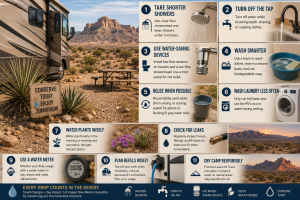
This is the single most impactful hardware change you can make. Low-flow showerheads with a pause or shutoff button — widely available for $15 to $25 — bring flow rates down to 1.25 to 1.5 gallons per minute and let you shut off the stream while lathering. The difference is immediate and significant. At 1.5 gpm with a pause, a thorough shower can come in under 5 gallons. That’s a 70 percent reduction from a conventional setup without feeling like you’ve given anything up.
The Navy Shower — It’s Worth Trying
Wet down. Water off. Soap up completely. Water on briefly to rinse. Total usage: under 2 gallons for a practiced rinse. It takes a few tries to feel natural, but experienced desert travelers swear by it. Not everyone sticks with it as a daily routine, but having it in your repertoire for days when water supply is limited is genuinely useful.
Gym Showers When Available
If you’re staying near a park or facility with shower access — many RV parks in the Albuquerque area have on-site facilities — using them occasionally takes the pressure off your fresh tank entirely. Worth factoring in as a regular option rather than a backup.
Managing RV Tanks Intelligently in Dry Conditions
Good RV tank management in the desert has some specific considerations that differ from wetter climates.
Fresh Tank Strategy
Even on full hookups, knowing your fresh tank level and keeping it reasonably full is wise practice in the desert Southwest. Water pressure at some parks and campgrounds in the region can be inconsistent — seasonal demand, infrastructure age, and drought restrictions can all affect it. A full fresh tank gives you a comfortable buffer when pressure drops unexpectedly.
Check your tank gauge regularly. In hot, dry conditions, evaporation from improperly sealed connections is a real (if slow) water loss. Make sure connections are snug and inspect flexible hoses seasonally for cracking that the desert heat can accelerate.
Gray Tank: Keep It Closed and Managed
Leaving the gray valve open when on full hookups is a common mistake. It causes buildup at the low end of the tank and dries out the P-traps, which leads to odor. Better practice in any climate — but especially relevant in the dry desert air where evaporation in exposed drain components is faster — is to keep the valve closed, let the gray tank reach about two-thirds capacity, then dump with force. This flushes the line properly and keeps the system healthier.
Black Tank in Desert Heat
Hot, dry conditions affect your black tank differently than humid climates do. With less ambient moisture in the air, solids can dry out and compact faster than they would in a wetter environment, especially if you’re conserving water aggressively on flushes. The rule is use enough water to do the job — not more, not less. Underflushing to save water is one of those conservation shortcuts that backfires badly. Enzyme-based treatments help keep things moving properly. Use them consistently.
Kitchen and Dishwashing Habits That Actually Help
The kitchen is the second-biggest opportunity for water reduction after the shower — and the changes here are mostly behavioral rather than equipment-dependent.
Cook With Lids and Use One Pot When You Can
Every pot of uncovered boiling water sends steam into your RV’s air. In dry desert conditions, this isn’t a humidity problem the way it is in the Gulf Coast or Southeast — but it is unnecessary water use. Lid on the pot. Use the smallest pot or pan the meal actually requires. These habits reduce both cooking water use and the ambient moisture that your ventilation system then has to deal with.
Wash Dishes in a Basin, Not Under Running Water
Fill a small basin with wash water and a seperate rinse basin rather than running the tap continuously. Old advice. Still genuinely the most water-efficient way to hand-wash dishes. The total water used in two basins is almost always less than a third of what a running tap would use for the same task.
Dry Scrape Before Washing
In dry desert air, food residue on dishes dries fast. A quick scrape or wipe before washing reduces the water needed to clean effectively. Small habit. Real impact over weeks of daily cooking.
Drinking Water: Don’t Waste What You Need Most
This one seems obvious but gets overlooked. Keep a dedicated water container in the fridge rather than running the tap every time you want a cold drink. Use a water filter pitcher or a built-in RV filter so you’re not burning through bottled water — production and transport of bottled water is itself a resource-intensive process that runs counter to the conservation mindset.
Desert travel water tips from experienced Southwest travelers consistently include one habit that seems minor: drink proactively rather than reactively. In low-humidity desert air, you lose water through respiration and skin evaporation faster than you feel thirsty. Staying ahead of hydration means you’re actually using the water you carry more effectivley — your body performs better and you need less of everything else.
Sustainable Habits Beyond the Tanks
Sustainable RV habits in a desert environment extend beyond what comes out of your taps. Cleaning products matter — biodegradable soaps and detergents are the right choice when any gray water might come into contact with desert soil or wash into storm drainage that connects to natural water sources. The desert ecology around Albuquerque and throughout New Mexico is genuinely sensitive. What you put into the system matters.
Vehicle washing — if you’re washing your rig or tow vehicle — is worth doing at a commercial wash facility rather than at your site. Commercial washers recycle water. Running a hose at your site doesn’t. Small distinction. Different outcome for the aquifer.
For travelers who are curious about the broader context of living and traveling sustainably in this part of New Mexico — what the community values, what the landscape requires — the content on what life in Albuquerque is really like gives a grounded picture that goes beyond the visitor experience.
Choosing the Right Base for Desert RV Travel
The park you stay at affects your water management options significantly. A well-maintained park with reliable hookups, properly functioning water connections, and on-site shower facilities makes conservation easier and more natural. Leaky hookup connections and poorly maintained infrastructure work against every effort you make on the conservation side.
Albuquerque RV Park is set up well for extended stays in the desert Southwest — with the kind of infrastructure that supports responsible long-term living in an environment where resources require respect. Choosing where you park is part of the conservation equation.
For RV travelers who are newer to desert travel and want more context on what the lifestyle looks like out here — the rhythms, the adjustments, the things that experienced desert RVers know that first-timers discover slowly — the RVing lifestyle and travel resource is a useful read before or during your first desert season.
Frequently Asked Questions
How much water does an RV traveler typically use per day in the desert?
Most long-term RV travelers use between 20 and 45 gallons per person per day. In a desert environment, conservation-conscious travelers can bring that down to 15 to 20 gallons per person without sacrificing meaningful comfort — primarily through shower habits, dishwashing technique, and mindful tap use. The shower accounts for the largest single share of daily consumption and is where the biggest reductions are found.
Is New Mexico water safe to drink from RV park hookups?
Municipal water in Albuquerque and most established RV parks in New Mexico is treated and meets federal drinking water standards. However, some travelers prefer to use an inline water filter on their hookup connection as a standard precaution — this reduces sediment and any taste issues from older infrastructure or mineral content in desert groundwater. It’s a reasonable practice in any arid region where groundwater mineral concentration tends to be higher than in wetter climates.
What is the single best change I can make to save water while RVing in the desert?
Switching to a low-flow showerhead with a pause button is consistently the highest-impact single change. It can reduce shower water use by 50 to 70 percent without requiring any change in daily routine beyond the habit of using the pause feature while soaping up. At under $25, the return on investment is almost immediate, and the difference across a multi-week or multi-month desert stay is measured in hundreds of gallons.
Why does New Mexico have water scarcity if the Rio Grande runs through it?
The Rio Grande is a heavily allocated river — its water is spoken for by interstate compacts between Colorado, New Mexico, and Texas, as well as by treaty obligations to Mexico. In drought years, the river’s flow can drop dramatically, sometimes to near-zero in some stretches. The population centers of New Mexico also rely heavily on underground aquifer systems that recharge far more slowly than they’re currently being drawn down. The combination of these factors makes water a genuinely constrained resource even in a state with a major river running through it.
How should I handle my RV black tank differently in desert conditions?
In hot, dry desert conditions, the main risk is solids drying and compacting faster than they would in humid environments — particularly if you’re conserving water aggressively on toilet flushes. Use enough water with each flush to keep things moving; underflushing is a false economy in the black tank. Enzyme-based treatments work well in desert heat and should be used consistently. Dump more frequently than you might in other climates during very hot stretches.
Are there water restrictions I should know about in Albuquerque for RV travelers?
Albuquerque’s water utility — the Albuquerque Bernalillo County Water Utility Authority — periodically implements conservation measures during drought conditions, which can affect outdoor water use including vehicle washing at sites. Restrictions are typically announced publicly and posted at parks. Staying aware of the current conservation stage and following guidelines is both a legal requirement when restrictions are in effect and a basic expression of respect for the community you’re staying in.